Hand/Finger Geometry
Hand geometry biometrics verify identity by measuring the shape and dimensions of the hand and fingers, offering fast, low-intrusion authentication widely used in access control and time-and-attendance systems.
This biometric approach uses the geometric form of the hand to confirm an individual's identity. Because human hands are not unique, specific features must be combined to ensure reliable verification. Some hand-scan devices measure just two fingers; others measure the entire hand. These features include characteristics such as finger curves, thickness, and length; the height and width of the back of the hand; the distances between joints; and overall bone structure. It should be noted that, although the bone structure and joints of a hand are relatively constant traits, other influences such as swelling or injury can disguise the basic structure of the hand. This could result in false matches and false non-matches; however, the amount of acceptable distinctive matching can be adjusted for the level of security needed.
To register in a hand-scan system, a hand is placed on a reader's covered flat surface. This placement is guided by five guides or pegs that correctly position the hand for the cameras. A succession of cameras captures 3-D images of the sides and back of the hand. Acquiring the hand scan is a fast and simple process.
The hand-scan device can process the 3-D images in 5 seconds or less, and hand verification usually takes less than 1 second. The image-capturing and verification software and hardware can easily be integrated into standalone units. Hand-scan deployments that include a large number of access points and users can be centrally administered, eliminating the need for individuals to register on each device.
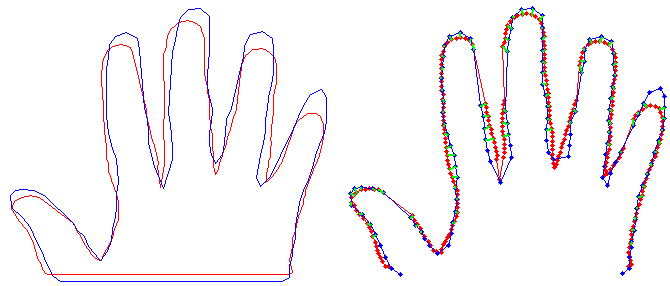
Internationally, many airports use hand-scan devices to permit frequent international travelers to bypass waiting lines for various immigration and customs systems. Employers use hand scan for entry/exit, recording staff movement, and time/attendance procedures. This can go a long way toward eradicating the age-old problem of buddy-clocking and other deceptive activities.
Hand scanning can be easily combined with other biometrics, such as fingerprint identification. A system in which fingerprints are used for infrequent identification and hand scanning is used for frequent verification would create a two-tiered structure. The hand-scan component, used frequently, allows identity verification, or 1:1 (one-to-one) verification, that ensures the user is who they claim to be.
The fingerprint identification component, used infrequently, confirms who the user is and accurately identifies the user in a 1:N (one-to-many) identification compared against numerous records. Some anthropologists suspect that human intelligence has evolved due in large part to the shape of the hand. While the hand hasn't changed much in a long time, it's now being put to a new use: verifying its owner's identity.
Every hand is unique. Hand geometry scanners such as those made by Recognition Systems Inc. take over 90 measurements of the length, width, thickness, and surface area of the hand and four fingers — all in just 1 second. The technology uses a 32,000-pixel CCD digital camera to record the hand's three-dimensional shape from silhouetted images projected within the scanner. The scanner disregards surface details, such as fingerprints, lines, scars, and dirt, as well as fingernails, which may grow or be cut from day to day.
When a person uses the scanner, it compares the shape of the user's hand to a template recorded during an enrollment session. If the template and the hand match, the scanner produces an output — it may unlock a door, transmit data to a computer, verify identification, or log the person's arrival or departure time. During enrollment, which takes approximately 30 seconds, the user places their right hand in the reader three times. The unit's internal processor and software convert the hand image into a 9-byte mathematical template, which is the average of the three readings. The user's template may reside in internal memory (capable of holding over 27,000 users), or on other media such as a hard disk or smart card chip.
As opposed to technologies such as fingerprint, voice recognition, and facial recognition, where a multitude of vendors compete via their proprietary technology, hand geometry technology is dominated by one company, Recognition Systems, Inc. Finger geometry is led by Biomet Partners.
RSI's method for capturing the biometric sample is fairly straightforward. To enroll, the user places their hand palm-down on the reader's surface. The user then aligns their hand with the five pegs designed to indicate the proper location of the thumb, forefinger, and middle finger. Three placements are required to enroll on the unit; the enrollment template is a representation of the most relevant data from the three placements.
RSI's units use a 32,000-pixel CCD (charge-coupled device) digital camera, inferring the length, width, thickness, and surface area of the hand and fingers from silhouetted images projected within the scanner. Over 90 measurements are taken, and the hand and fingers' characteristics are represented as a 9-byte template. Biomet Partners' technology is similar but draws on the shape and characteristics of the index and middle finger. The data is saved as a 20-byte template.
Hand geometry is a relatively accurate technology, but it does not draw on as rich a data set as finger, face, or iris. A decent measure of the distinctiveness of a biometric technology is its ability to perform one-to-many searches — that is, its ability to identify a user without the user first claiming an identity. Hand geometry does not perform one-to-many identification, as similarities between hands are not uncommon. Where hand geometry does have an advantage is in its FTE (failure-to-enroll) rate, which measures the likelihood that a user is unable to enroll in the system.
Fingerprint, by comparison, is prone to FTEs due to poor-quality fingerprints; facial recognition requires consistent lighting to properly enroll a user. Since nearly all users have the dexterity needed to use hand geometry technology, fewer employees and visitors will need to be processed outside the biometric system. Hand geometry is occasionally misunderstood as "palm reading," since the placement of the hand palm-down on the reader can be confusing to those unfamiliar with the technology.
Strengths
Ease of use — submitting the biometric is straightforward, and with proper training can be done with few misplacements. The exception may be elderly users or those with arthritic hands, who may be unable to easily spread their fingers and place their hand on the unit's surface. The unit also works fairly well with dirty hands.
Resistant to fraud — short of casting a model of an enrolled person's hand and fingers, it would be difficult and time-consuming to submit a fake sample. Since much of the value of hand scan lies in its deterrent effect in time and attendance scenarios, it would rarely be worth the effort to attempt a fake submission.
Template size — using RSI as the standard-bearer of hand scan, a template size of 9 bytes is extremely small — orders of magnitude smaller than most other biometric technologies. By contrast, finger scan biometrics require 250-1000 bytes, and voice scan biometrics commonly require 1500-3000 bytes. This facilitates storage of a large number of templates in a standalone device, which is how many hand-scan devices are designed to work. It also facilitates card-based storage, as even magstripe cards have ample room for 9-byte samples.
User perceptions — as opposed to facial scan or eye-based technologies, which can encounter some resistance, the use of hand geometry is not problematic for the vast majority of users. It carries very little of the stigma associated with other authentication methods.
Weaknesses
Static design — as opposed to other biometrics, which can take advantage of technological breakthroughs like advances in silicon or camera quality, hand scan has remained largely unchanged for years. Its size precludes its use in most logical access scenarios, where a compact design may be a prerequisite.
Cost — hand-scan readers cost approximately $1400-2000, placing them toward the high end of the physical security spectrum. Finger-scan readers, whatever their strengths and weaknesses, can be much less expensive, in the $800-1200 range. Injuries to hands — as with all biometrics, physiological changes can cause users to be falsely rejected. Injuries to hands are fairly common and could make the use of systems such as RSI's impossible.
Accuracy — although generally more reliable than behavioral biometrics such as voice or signature, hand geometry, in its current form, cannot perform one-to-many searches, but is instead limited to one-to-one verification. This limits its use in many different applications.
Recognition Systems Inc. has significantly enhanced the biometric technology in its hand scanners. By maintaining a low False Reject Rate (the probability that the device will reject an authorized user), while maintaining a high deterrent to unauthorized access, RSI's units process large numbers of people with minimal delays. The crossover of False Reject and False Accept rates for RSI's hand geometry readers is 0.1%. These optimal error rates were documented in independent testing at Sandia National Laboratories. Subsequent field results from thousands of users and hundreds of thousands of transactions confirmed the Sandia findings.
Among biometric technologies, Sandia reported that hand geometry had the highest user acceptance of all devices tested. With a high level of security, ease of use, and non-threatening technology, hand geometry has become the most widely accepted biometric technology in use today.
RSI hand geometry scanners verify identity at the front entrances of over half the nuclear power plants in the U.S. At the 1996 Olympic Games, RSI's units were integrated with the Olympic Village security system to process millions of transactions with minimal delay. The U.S. Immigration and Naturalization Service (INS) uses RSI hand geometry scanners to allow over 60,000 frequent travelers to bypass immigration lines (through the INSPASS program). The drastic reduction in microprocessor costs in recent years has brought affordable hand geometry technology to the commercial market. Biometrics are no longer found only in nuclear power plants. Day care centers, athletic clubs, obstetrics wards, and police departments now use RSI's scanners. Tomorrow will bring ever-expanding applications for this thoroughly time-tested technology — for financial transactions, ticketless travel, and new business and residential applications where high security is a major concern.
Hand geometry is currently among the most widely used biometric technologies, most suitable for access control and time-and-attendance applications. As opposed to more exotic biometric technologies, whose implementations may be quite few and far between, hand scan is used reliably at thousands of workplaces, universities, apartment buildings, and airports — anywhere requiring reasonably accurate, non-intrusive authentication. The nature of hand geometry technology is such that most projects are fairly small-scale and involve only a handful of readers, though there are some projects that incorporate dozens of readers.
Perhaps the most frequently used and most successful hand-scan project is INSPASS (Immigration and Naturalization Service Passenger Accelerated Service System), which allows frequent travelers to bypass long immigration lines at international airports in Los Angeles, Miami, Newark, N.J., New York City, Washington, San Francisco, Toronto, and Vancouver. Qualified passengers, after enrolling in the service, receive a magstripe card encoded with their hand-scan information. Instead of being processed by passport control personnel, INSPASS travelers swipe their card, place their hand, and proceed with their I-94 to the customs gate.
Nearly 50,000 people have enrolled in the service, and approximately 20,000 verifications take place every month. Travelers from 30 different countries are qualified to register for INSPASS; budget permitting, the near-term objective is to roll out the INSPASS project to over 20 airports in the U.S.
Not yet implemented, but expected to begin at some point in 2000, is another high-profile hand-scan project in Israel known informally as "Basel." Designed to control access to a road connecting the Gaza Strip and the West Bank, Basel will incorporate both hand scan and facial scan; an overriding objective in the design of this biometric system was to provide maximum security while allowing for authentication under challenging environmental conditions. Dozens of biometrically enabled turnstiles will feature proximity-based smart cards, hand-scan readers, and cameras to perform facial scan matching. Although neither face nor hand is ideal for this application, the combination of the two allows for maximum efficiency in processing what will be over 30,000 Palestinian workers each day. The only major implementation of hand geometry by a vendor other than RSI is Disney's verification of season pass holders via two-finger geometry. This is both a convenience measure and a deterrent, as season pass holders are able to bypass long lines but cannot give their season passes to friends.
Though the underlying biometric technology is mature, hand geometry is projected to be one of the slower-growing biometric technologies through 2007. Because the range of applications in which hand geometry is typically used is limited to access control and time and attendance, it will draw a progressively smaller percentage of biometric revenues. Overall, hand geometry revenues are projected to grow from $27.7m in 2002 to $97.4m in 2007. Hand geometry revenues are expected to comprise approximately 2.5% of the entire biometric market.
Legacy links (no longer active) (1)
- http://biometrics.cse.msu.edu/hand_geometry.html